There was a shooting at my workplace. The building was on lockdown for 30 minutes, one person died, one person was arrested. I was working from home.
On the same day of the shooting, my workplace sent everyone an e-mail with several different resources that were available to us to deal with what was immediately identified as a traumatic incident along with clear support for employees to communicate with their team about how the shooting was affecting them including needs for time off to heal. The e-mail also educated employees on how trauma can manifest in the days, weeks, and months that follow and shared how research suggests that humans tend to benefit from having support from their loved ones and colleagues in the immediate aftermath of a traumatic event.
The next morning, even more resources were shared with the promise of even more to come, and support was reiterated along with evidence that action was being taken to learn from what happened and enhance the safety of our workplace even further. By the afternoon, yet another e-mail with more resources was sent out to the staff.
One of the above-mentioned resources included a counselor who would be available in the building the following business day. On that day, leadership from other locations all pitched in to buy lunch for our entire building staff to show support and solidarity.
* * *
I used to volunteer at a hospital in the emergency department supporting patients coming in related to domestic violence and sexual assault. In order to be qualified to do this, I took a 40 hour training, during which I learned that the reaction of the first few people a trauma survivor discloses to has a notable impact on whether or not they will go on to develop PTSD. We were also trained to prepare the patient for what to expect in the ensuing days and months, just like my employer did in their e-mail.
* * *
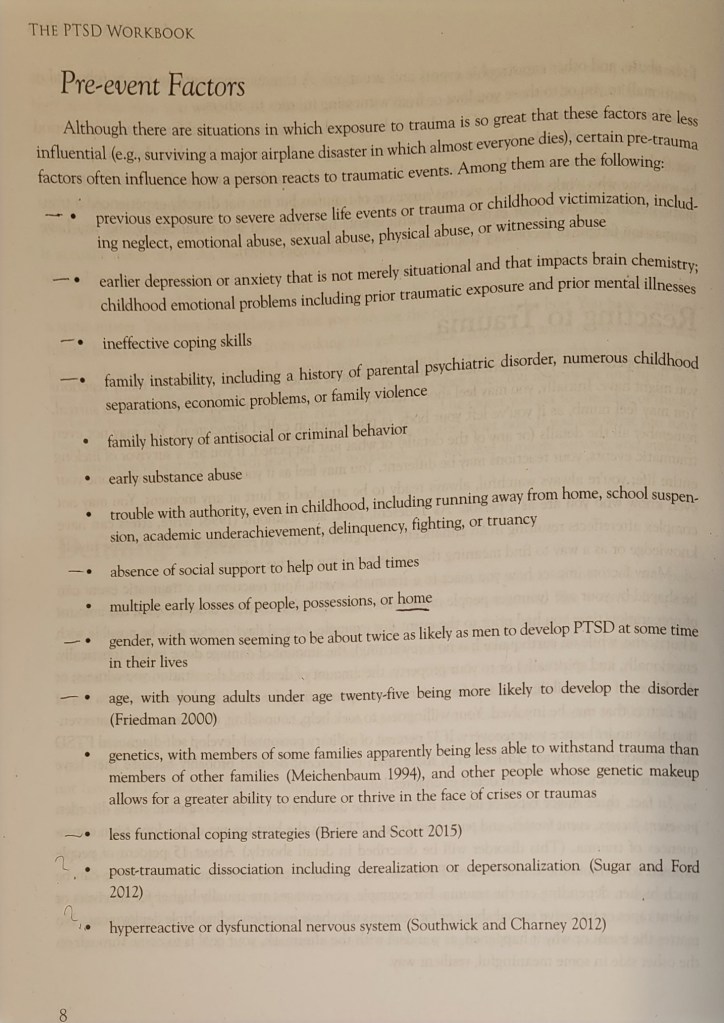
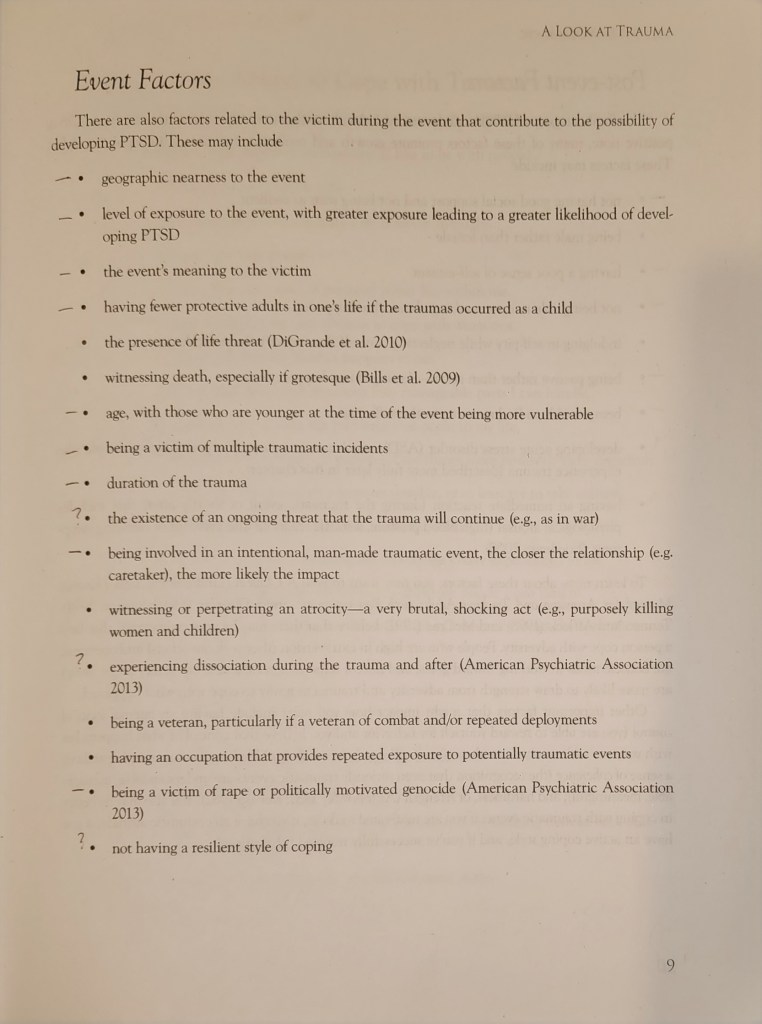
My therapist and I were working through The PTSD Workbook together. One of the first things I learned from it were the different factors that influence how someone will react to trauma. The factors are categorized in time for before the trauma, during, and after.
I spent many years after being raped struggling with what had happened, unable to identify it and unable to heal from it. In my most lucid moments before 2016, I could admit to myself that I felt traumatized by something that wasn’t traumatic. Obviously now I understand that what I went through was trauma. But years of blaming and hating myself for “overreacting” to something that “wasn’t a big deal” hasn’t ever really left me. Understanding not only that what I went through was trauma but also that there were additional factors that influenced my developing PTSD felt nurturing to the lingering wounds of my denial.
Here are the factors outlined in The PTSD Workbook.

* * *
Getting all these e-mails, I’m grateful that my workplace is clearly trauma informed, vigilant, and caring about employee wellbeing. I want to take a moment to acknowledge that someone’s life was taken from them, and there is no healing from that. I also want to acknowledge the ripple effects of this traumatic event for those who are affected. It’s nice that support is available to those of us who work there, but it’s awful that this has happened, and there are also people who are not employees who will be impacted by this.
A few other things have come up for me when reading the e-mails. Something like resentment. I think, what if you already have PTSD? Then what? I think, must be nice to have trauma that people understand and to be reacting to it when people understand.
I don’t agree with those thoughts, but I can boil them down to something I do agree with.
What if immediately upon experiencing sexual assault, victims and those around them were able to recognize it as trauma? What if as soon as it happened, we felt encouraged and safe to confide in our loved ones and colleagues, who were all trauma informed? What if what happened to us was instantly validated as an injury, worthy of being treated and healed? What if those around us were proactive about providing us with support or resources which were readily available, free, easy to access, and specific to treating trauma?
PTSD can’t be diagnosed until six months after the trauma occurs. Having a post-traumatic stress reaction to trauma is normal. It becomes PTSD when it doesn’t go away. What if despite all this support, an employee develops PTSD? Six months from now, will my workplace be as understanding if someone who witnessed the shooting needs to work from home as a result of triggers related to the trauma?
* * *
What if back in 2011, or 2012, or anytime before 2016, anyone who had a chance to know I’d been raped, including and especially myself, could have recognized what happened and called it trauma? What if anyone could have recognized what was happening to me as symptoms of post-traumatic stress? What if I or anyone around me could have recognized that I was vulnerable and known how to do something about it? Where would I be now?
* * *
I had a few takeaways from the factors in The PTSD Workbook. One is, it’s not your fault — not just the trauma but how the trauma manifests. For pre-event factors, there’s almost nothing within an individual’s control there other than having effective coping strategies. What if our early education included therapy techniques to develop resilience and get ahead of mental health struggles in young people? What if we were really taught how to talk about our feelings and taught about healthy ways to deal with hard situations?
For event factors, once again, there’s very little within the survivor’s control. I want to highlight that one of the factors is the trauma itself being rape. I wonder if that’s because sexual assault for the most part happens in private, is shrouded in secrecy, and is protected by taboo. What if it wasn’t so hard to disclose? What if it didn’t feel so risky to talk about it? What if there wasn’t so much shame surrounding sex?
Other than being specifically banned by Avery from sharing with anyone what was happening and being groomed and gaslit into believing rape was sex, I don’t think I had the ability to even say something like, “I think I had sex, but I feel kind of weird about it,” even though I did. I didn’t know that if something didn’t feel right, something wasn’t right. It’s incredibly frustrating to remember myself thinking, “I feel raped by something that wasn’t rape” years before I finally understood I felt raped by something that was rape.
Sex doesn’t feel like rape. Sex doesn’t feel like trauma. I wish I’d known that. I wish I was equipped with so much more knowledge than I had. I know that there’s some controversy around at what point we should be talking to children about sex, but doesn’t that controversy in and of itself suggest that sex is supposed to be secret, and what does that do other than greenlight abusers who say, “Don’t tell anyone about this”?
Post-event factors: not having good social support. Trauma itself is isolating. It’s uncomfortable to talk about. A trauma survivor’s emotions can be volatile at times. Ultimately, everyone needs to take care of their needs, and it’s okay for loved ones of trauma survivors to set boundaries and not be able to talk to a survivor about their trauma. But wouldn’t it be nice if we all understood how to talk about trauma, even if it doesn’t always work for us? The fact that it’s such a difficult thing to deal with, both firsthand and secondhand, is not helping anyone. If we all had more training before we are faced with trauma in action, we would be better able to handle it if and when we do encounter it.
My employer’s quick response is a great example of this. They jumped right in, armed with knowledge, and I believe employees who were exposed to the trauma will be better off as a result.
* * *
What if before I ever met Avery, I had been taught how to cope with overwhelming emotions, difficult situations, the chaos and unpredictability of life, in a healthy way?
What if I had been guided from an early age to develop positive self-esteem? What if my poor self-esteem had been urgently addressed?
What if I had learned to trust my intuition?
What if I had felt like therapy was an opportunity for everyone to learn to be their best self and to navigate their own life more smoothly, rather than a punishment or reserved for people with “real” problems?
What if I felt empowered to ask for help?
What if I had more adults in my life who I felt safe to confide in?
What if the first time Avery ever raped me, I had access to resources to help me right away? What if the first had been the last?
What if the information I did share with anyone had been enough for someone to see I’d been through trauma?
What if the people around me were better equipped to identify and meet my needs, or direct me to someone or somewhere that could?
What if when I did seek help, I had been able to find it easily?
What if the help I found the first time had been the help I needed?
The what-if game isn’t going to change what happened to me or how it turned out. But what if it could change something for someone? I hope from reading this, you take away that it’s impactful to understand trauma before you have to, and it’s impactful to arm yourself with tools to cope with life before you need them.
 Set the Story Free